


Get Latest Nov-2025 Real FCP_FSM_AN-7.2 Exam Questions and Answers FREE
Truly Beneficial For Your Fortinet Exam (Updated 34 Questions)
NEW QUESTION # 16
Refer to the exhibit.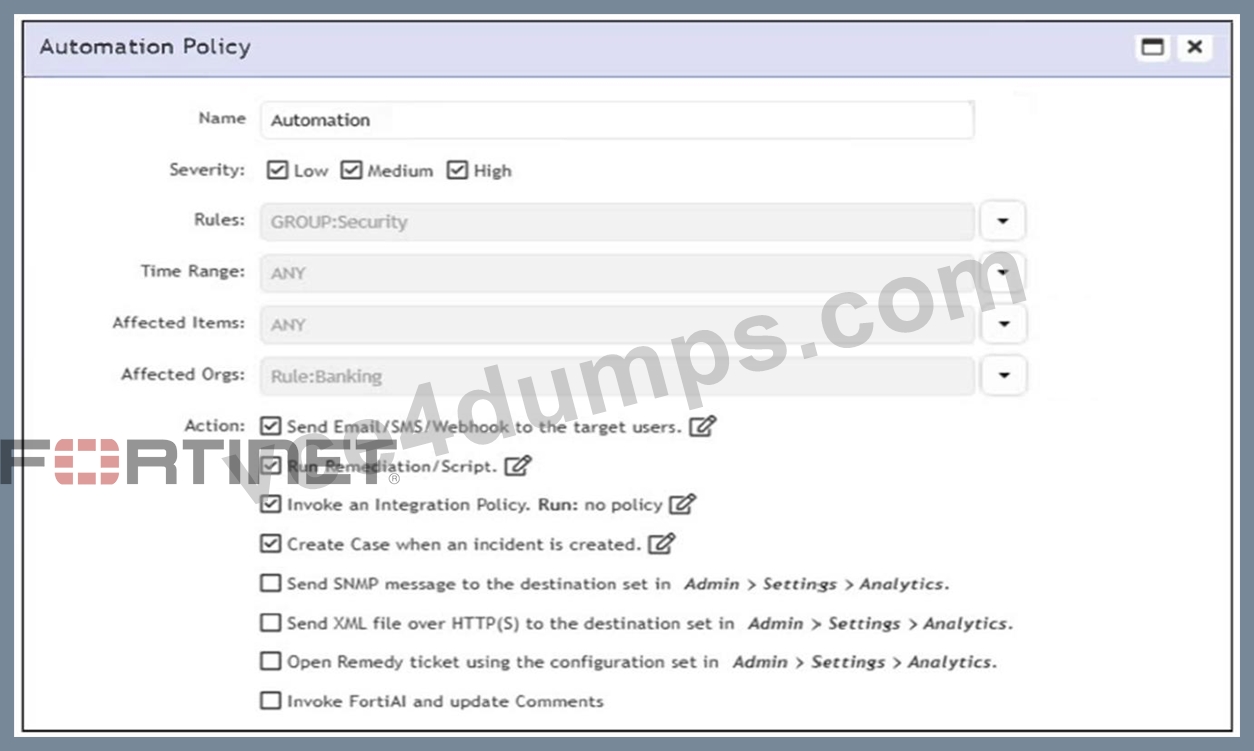
According to the automation policy configuration shown in the exhibit, what happens if an associated rule triggers?
- A. FortiSIEM sends an email, because that is first on the list.
- B. FortiSIEM performs all selected actions.
- C. FortiSIEM runs the remediation script, because that takes precedence over all other options.
- D. FortiSIEM fails to the integration policy, because no policy is defined.
Answer: B
Explanation:
When an associated rule triggers, FortiSIEM performs all selected actions in the automation policy. In this case, it will send an email/SMS/webhook, run the remediation script, invoke the integration policy (even if none is currently defined), and create a case. All checked actions are executed.
NEW QUESTION # 17
Refer to the exhibit.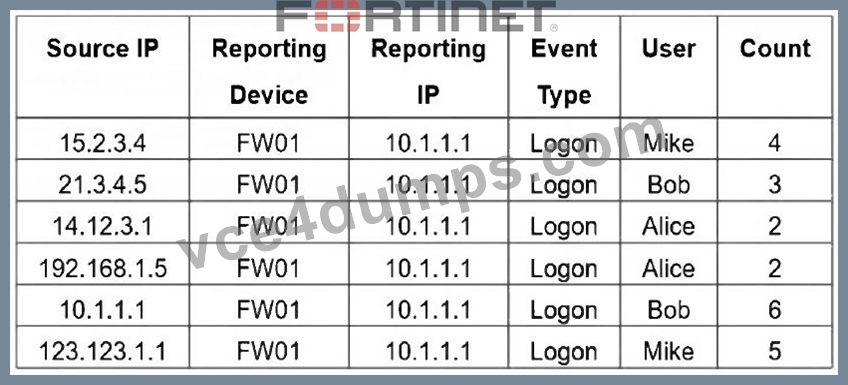
If you group the events by User and Count attributes, how many results will FortiSIEM display?
- A. Three
- B. Two
- C. One
- D. Five
- E. Six
Answer: D
Explanation:
Grouping by User and Count yields five unique pairs: (Mike,4), (Bob,3), (Alice,2), (Bob,6), (Mike,5).
NEW QUESTION # 18
Refer to the exhibit.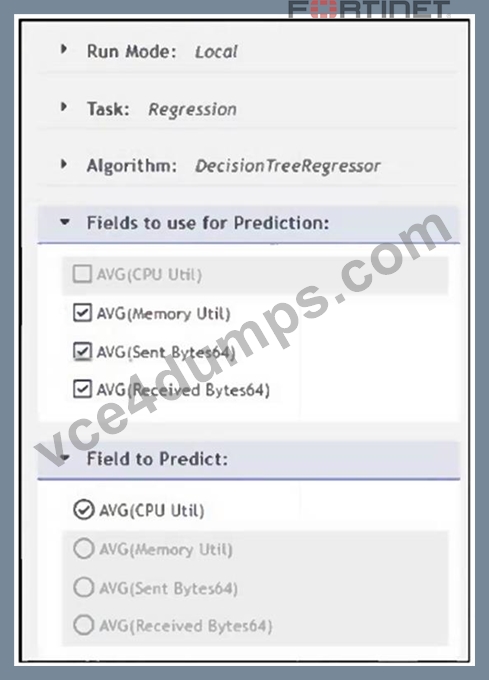
What will happen when a device being analyzed by the machine learning configuration shown in the exhibit has a consistently high memory utilization?
- A. FortiSIEM will update the regression tables for memory utilization, and average sent and received bytes.
- B. FortiSIEM will lower the CPU utilization trigger requirement for CPU utilization.
- C. FortiSIEM will trigger an incident for high memory utilization.
- D. FortiSIEM will update the model with a higher memory utilization average value.
Answer: D
Explanation:
In the configuration shown, FortiSIEM uses Memory Util, Sent Bytes, and Received Bytes as input features to predict CPU Utilization via a regression model. If a device shows consistently high memory utilization, the model will incorporate that into its training data and update itself with a higher average value for memory utilization, influencing future CPU utilization predictions.
NEW QUESTION # 19
Refer to the exhibit.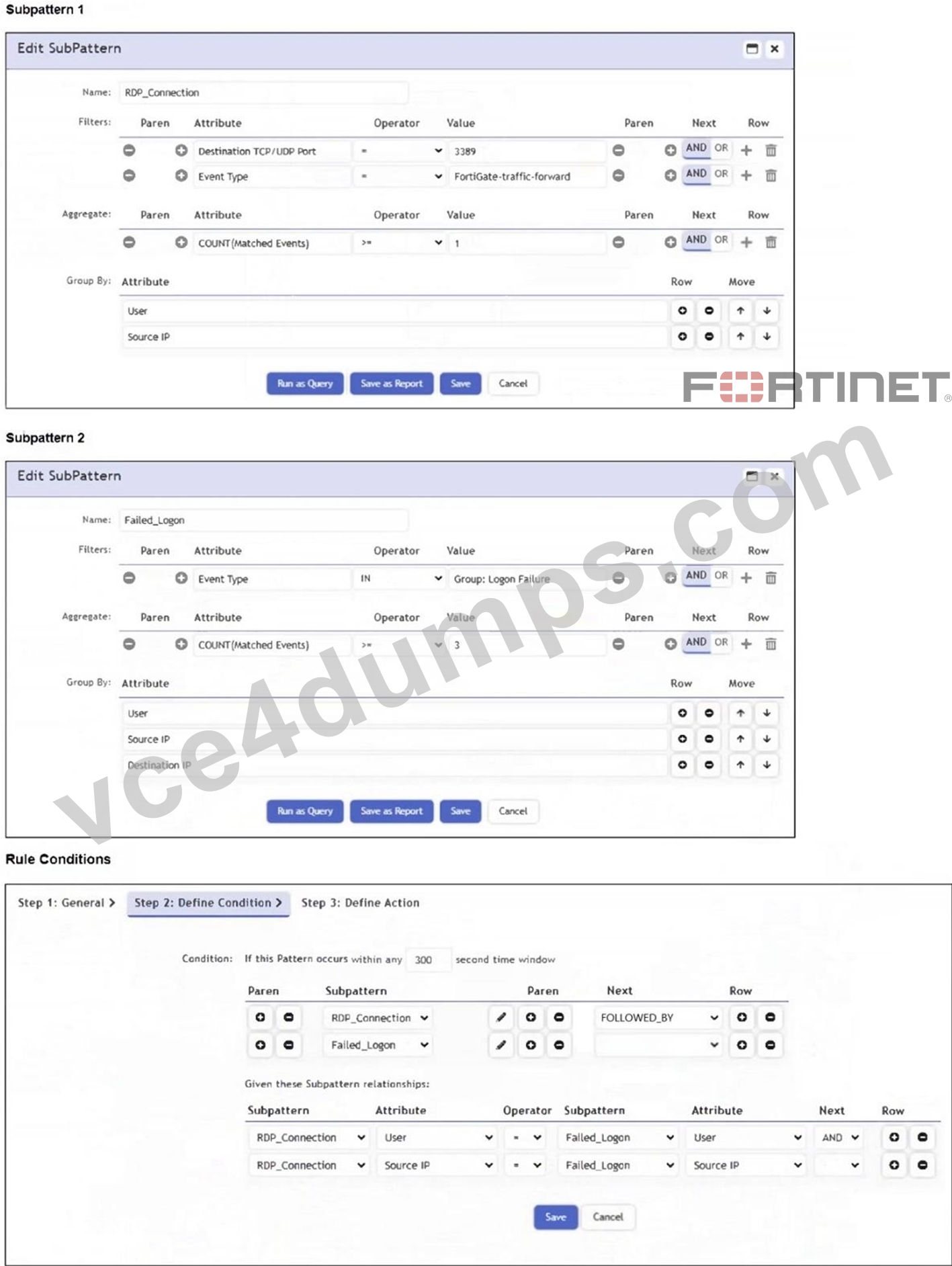
Which two conditions will match this rule and subpatterns? (Choose two.)
- A. A user fails twice to log in when connecting through RDP.
- B. A user connects to the wrong IP address for an RDP session five times.
- C. A user runs a brute force password cracker against an RDP server.
- D. A user using RDP over SSL VPN fails to log in to an application five times.
Answer: C,D
Explanation:
The user initiates an RDP session (Subpattern 1) and then fails to log in multiple times (Subpattern 2 with COUNT(Matched Events) >= 3) - both from the same Source IP and User within 300 seconds.
The brute force attempts typically involve a successful RDP connection followed by multiple failed logins, satisfying the sequence and grouping conditions in the rule.
NEW QUESTION # 20
Refer to the exhibit.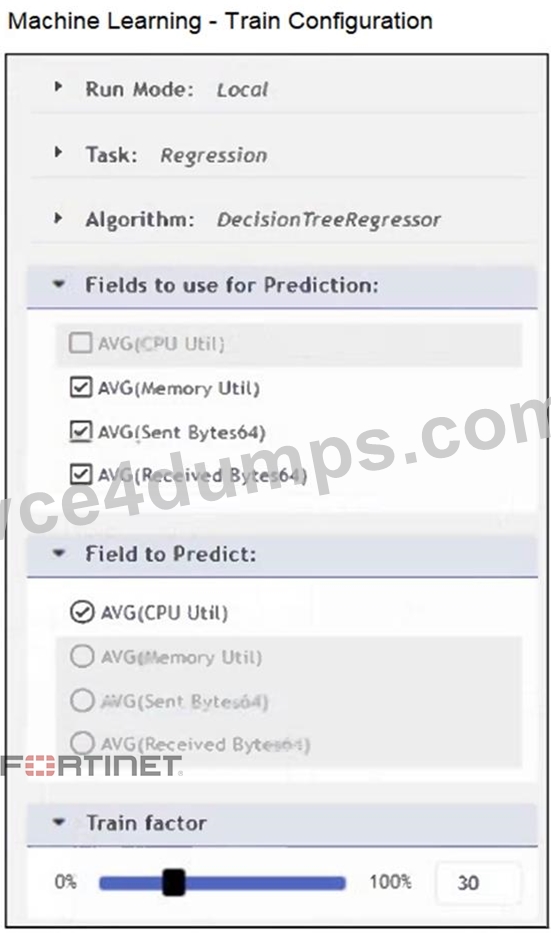
The configuration shown in the exhibit is incorrect.
What must you change to allow this configuration to be successfully applied to FortiSIEM?
- A. The Train factor must be 70% or greater.
- B. Run Mode must be set to ML.
- C. The selection in Fields to use for Prediction and Field to Predict must match.
- D. Only one AVG type field must be selected under Fields to use for Prediction.
Answer: B
Explanation:
The Run Mode is set to Local, which is not valid for training machine learning models in FortiSIEM. To apply this configuration correctly, the Run Mode must be set to ML, which enables proper model training and prediction using selected fields.
NEW QUESTION # 21
Refer to the exhibit.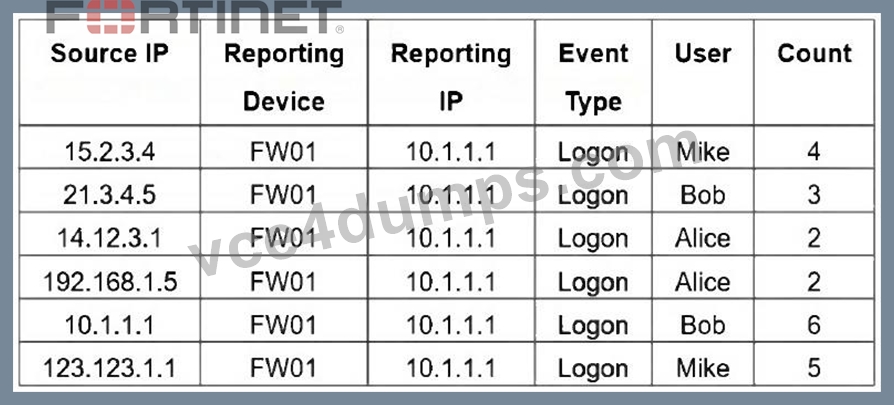
If you group the events by User, Source IP, and Count attributes, how many results will FortiSIEM display?
- A. Three
- B. Two
- C. Five
- D. Six
- E. Four
Answer: D
Explanation:
Grouping by User, Source IP, and Count means that each unique combination of those three attributes will be treated as a separate result. In the table, all six rows have distinct combinations of User, Source IP, and Count - so FortiSIEM will display 6 results.
NEW QUESTION # 22
Refer to the exhibit.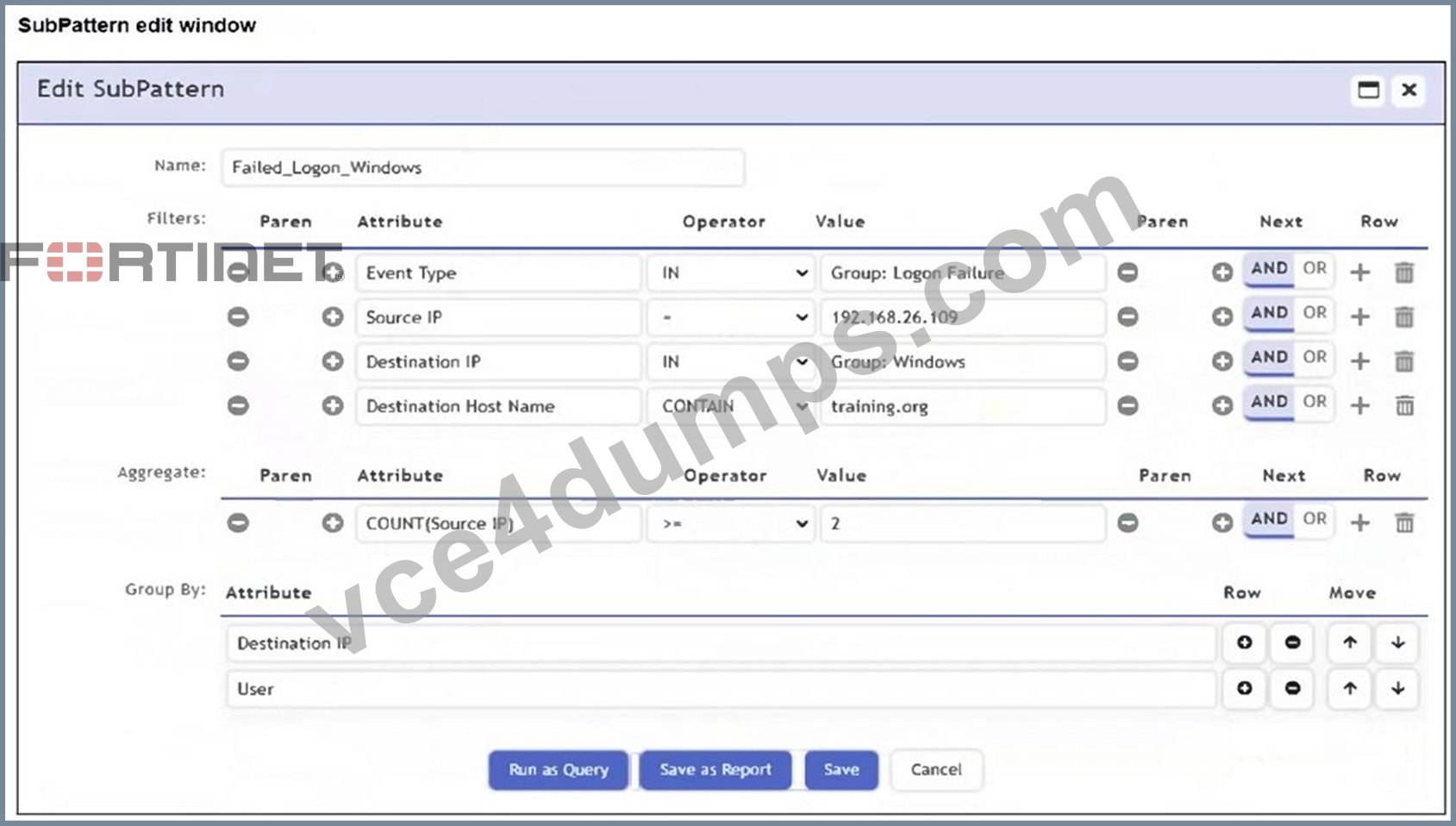
An analyst is troubleshooting the rule shown in the exhibit. It is not generating any incidents, but the filter parameters are generating events on the Analytics tab.
What is wrong with the rule conditions?
- A. The Aggregate attribute is too restrictive.
- B. The Event Type refers to a CMDB lookup and should be an Event lookup.
- C. The Destination Host Name value is not fully qualified.
- D. The Group By attributes restricts which events are counted.
Answer: D
Explanation:
The Group By attributes - Destination IP and User - cause the aggregation (COUNT(Source IP) >= 2) to apply within each unique combination of those groupings. This restricts the count calculation and can prevent the rule from triggering incidents, even if matching events exist in the Analytics tab.
NEW QUESTION # 23
Which running mode takes the most time to perform machine learning tasks?
- A. Regression
- B. Forecasting
- C. Local
- D. Local auto
Answer: C
Explanation:
In Local mode, FortiSIEM performs machine learning tasks using the full dataset without optimization shortcuts, making it the most time-consuming mode compared to Local Auto, Forecasting, or Regression.
NEW QUESTION # 24
How does FortiSIEM update the incident table if a performance rule triggers repeatedly?
- A. FortiSIEM updates the Incident Count value and Last Seen timestamp.
- B. FortiSIEM generates a new incident each time the rule triggers, and updates the First Seen and Last Seen timestamps.
- C. FortiSIEM changes the incident status to Repeated, and updates the Last Seen timestamp.
- D. FortiSIEM generates a new incident based on the Rule Frequency value, and updates the First Seen and Last Seen timestamps.
Answer: A
Explanation:
When a performance rule triggers repeatedly, FortiSIEM updates the existing incident by incrementing the Incident Count and refreshing the Last Seen timestamp. This avoids flooding the incident table with duplicates while still tracking repeated occurrences.
NEW QUESTION # 25
What can you use to send data to FortiSIEM for user and entity behavior analytics (UEBA)?
- A. FortiSIEM worker
- B. SSH
- C. FortiSIEM agent
- D. SNMP
Answer: C
Explanation:
The FortiSIEM agent can be used to send detailed endpoint data such as user activity and process behavior to FortiSIEM, which is essential for performing User and Entity Behavior Analytics (UEBA).
NEW QUESTION # 26
Refer to the exhibit.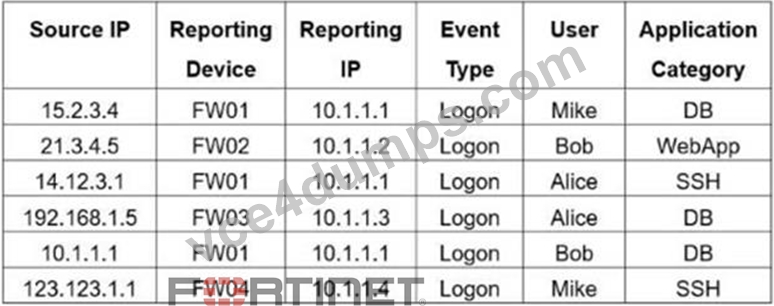
If you group the events by Reporting Device, Reporting IP, and Application Category, how many results will FortiSIEM display?
- A. Two
- B. One
- C. Five
- D. Six
- E. Four
Answer: C
Explanation:
Grouping by Reporting Device, Reporting IP, and Application Category yields five unique tuples: (FW01, 10.1.1.1, DB), (FW02, 10.1.1.2, WebApp), (FW01, 10.1.1.1, SSH), (FW03, 10.1.1.3, DB), and (FW04, 10.1.1.4, SSH).
NEW QUESTION # 27
What are two required components of a rule? (Choose two.)
- A. Detection Technology
- B. Exception policy
- C. Clear policy
- D. Subpattern
Answer: A,D
Explanation:
A Subpattern defines the specific conditions or event patterns the rule is designed to detect, and the Detection Technology specifies the type of detection logic (e.g., real-time, historical). Both are essential for a rule to function in FortiSIEM.
NEW QUESTION # 28
What can you use to send data to FortiSIEM for user and entity behavior analytics (UEBA)?
- A. FortiSIEM worker
- B. SSH
- C. FortiSIEM agent
- D. SNMP
Answer: C
Explanation:
The FortiSIEM agent can be used to send detailed endpoint data such as user activity and process behavior to FortiSIEM, which is essential for performing User and Entity Behavior Analytics (UEBA).
NEW QUESTION # 29
Refer to the exhibit.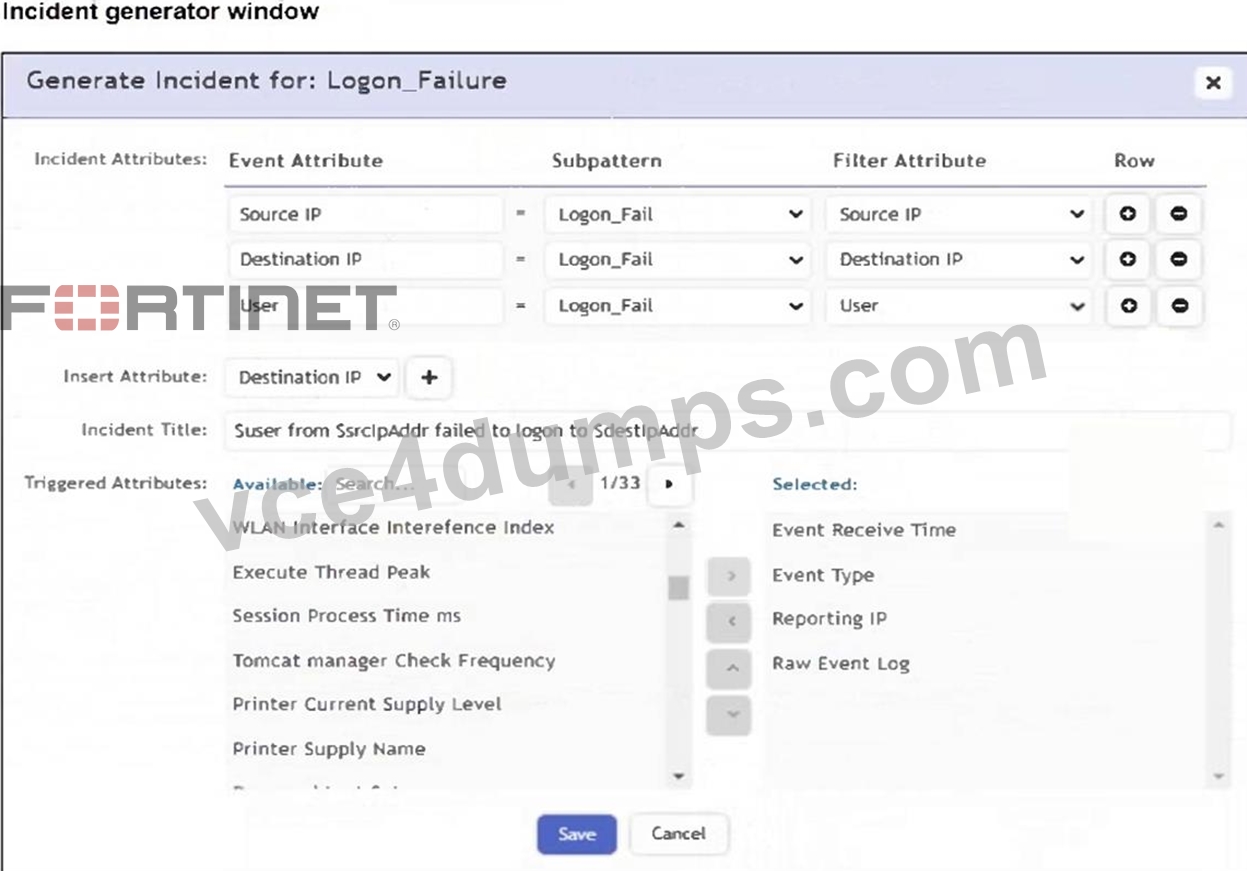
An analyst is trying to generate an incident with a title that includes the Source IP, Destination IP, User, and Destination Host Name. They are unable to add a Destination Host Name as an incident attribute.
What must be changed to allow the analyst to select Destination Host Name as an attribute?
- A. The Destination IP Event Attribute must be removed.
- B. The Destination Host Name must be selected as a Triggered Attribute.
- C. The Destination Host Name must be added as an Event type in the FortiSIEM.
- D. The Destination Host Name must be set as an aggregate item in a subpattern.
Answer: B
Explanation:
For an attribute like Destination Host Name to be used in the incident title, it must first be included in the Triggered Attributes list. Only attributes listed there are available for substitution in the title template (e.g., $destIpAddr, $srcIpAddr).
NEW QUESTION # 30
......
Fortinet FCP_FSM_AN-7.2 Exam Syllabus Topics:
| Topic | Details |
|---|---|
| Topic 1 |
|
| Topic 2 |
|
| Topic 3 |
|
| Topic 4 |
|
FCP_FSM_AN-7.2 dumps Free Test Engine Verified By It Certified Experts: https://passguide.vce4dumps.com/FCP_FSM_AN-7.2-latest-dumps.html