


[Jan 03, 2026] New D-DS-FN-23 Exam Dumps with High Passing Rate
Get D-DS-FN-23 Braindumps & D-DS-FN-23 Real Exam Questions
NEW QUESTION # 194
Which key role for a successful analytic project can provide business domain expertise with a deep understanding of the data and key performance indicators?
- A. Project Manager
- B. Business Intelligence Analyst
- C. Project Sponsor
- D. Business User
Answer: B
NEW QUESTION # 195
Consider the following itemsets:
(hat, scarf, coat)
(hat, scarf, coat, gloves)
(hat, scarf, gloves)
(hat, gloves)
(scarf, coat, gloves)
If the minimum support is 50%, what represents the complete list of frequent 2-itemsets?
- A. (hat, scarf), (hat, gloves)
- B. (hat, scarf), (hat, gloves), (scarf, gloves), (scarf, coat)
- C. (scarf, gloves), (scarf, coat) (hat, gloves)
- D. (hat, scarf), (scarf, coat), (coat, gloves)
Answer: B
NEW QUESTION # 196
You have been assigned to do a study of the daily revenue effect of a pricing model of online transactions.
All the data currently available to you has been loaded into your analytics database; revenue data, pricing data, and online transaction data.
You find that all the data comes in different levels of granularity. The transaction data has timestamps (day, hour, minutes, seconds), pricing is stored at the daily level, and revenue data is only reported monthly.
What is your next step?
- A. Report back to the business owner that the current data model does not support the business question.
- B. Interpolate a daily model for revenue from the monthly revenue data.
- C. Disregard revenue as a driver in the pricing model, and create a daily model based on pricing and transactions only.
- D. Aggregate all data to the monthly level in order to create a monthly revenue model.
Answer: A
NEW QUESTION # 197
After which phase of the data analytics lifecycle should you determine if the model needs any recalibration?
- A. Operationalize
- B. Data preparation
- C. Discovery
- D. Model planning
Answer: A
Explanation:
Recalibration of the model should be assessed during the Operationalize phase, as this is when the model is deployed and monitored in real-world conditions, making it easier to identify if it requires adjustments based on its performance.
NEW QUESTION # 198
Which characteristic applies only to Business Intelligence as opposed to Data Science?
- A. Supports solving "what if" scenarios
- B. Uses large data sets
- C. Uses only structured data
- D. Uses predictive modeling techniques
Answer: C
NEW QUESTION # 199
In a user-defined aggregate function, what is FFUNC?
- A. Window function
- B. Optional final calculation function
- C. State transition function
- D. Segment-level calculation function
Answer: B
Explanation:
In a user-defined aggregate function (UDAF), FFUNC refers to the optional final calculation function. It is used to perform any final calculation or transformation on the aggregated result before it is returned to the user.
NEW QUESTION # 200
A Data Scientist is assigned to build a model from a reporting data warehouse. The warehouse contains data collected from many sources and transformed through a complex, multi-stage ETL process.
What is a concern the data scientist should have about the data?
- A. It is too centralized
- B. It is not normalized
- C. It is too processed
- D. It is not structured
Answer: C
NEW QUESTION # 201
What describes the use of UNION clause in a SQL statement?
- A. Operates on both tables and queries and potentially increases both the number of rows and columns
- B. Operates on queries and potentially increases the number of rows
- C. Operates on queries and potentially decreases the number of rows
- D. Operates on tables and potentially decreases the number of columns
Answer: B
NEW QUESTION # 202
The graphic shows the values for the input Boolean attributes "A", "B", and "C". In addition, the graphic shows the values for the output attribute "class".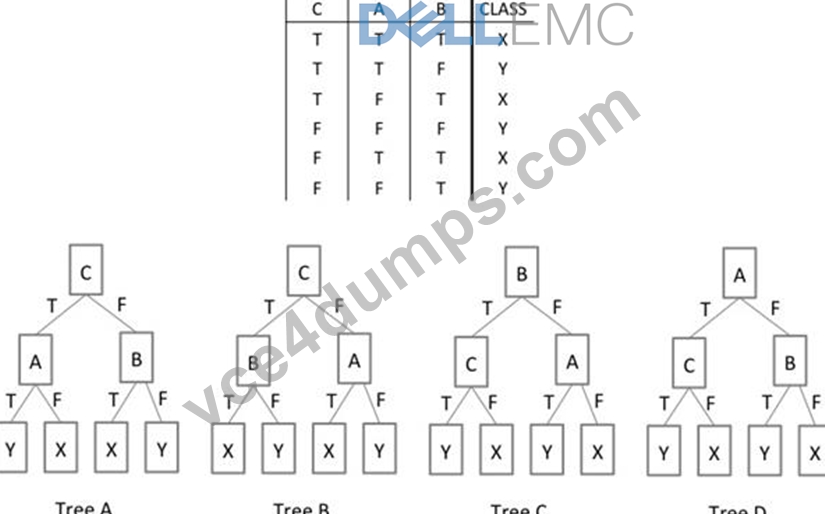
Which Decision Tree is valid for the data?
- A. Tree C
- B. Tree D
- C. Tree A
- D. Tree B
Answer: D
NEW QUESTION # 203
Based on the graphic, what should be done to begin addressing chart junk?
- A. Reduce the font size in the axis
- B. Remove the legend
- C. Remove the vertical gridlines
Answer: C
NEW QUESTION # 204
Which Hadoop service responds to requests for compute and memory resources?
- A. Application Master
- B. Application Manager
- C. Scheduler
- D. DataNode
Answer: C
Explanation:
The Scheduler in Hadoop is responsible for allocating compute and memory resources across various applications running on the cluster. It decides how resources are distributed based on policies and availability.
NEW QUESTION # 205
In addition to quantitative and technical skills, what is a key aspect of the profile of a data scientist?
- A. Proficient in Microsoft Project and Excel
- B. Project management and administrative skills
- C. Accounting and regulatory skills
- D. Curious and creative
Answer: D
NEW QUESTION # 206
How does Pig's use of a schema differ from that of a traditional RDBMS?
- A. Pig's schema requires that the data is physically present when the schema is defined
- B. Pig's schema is optional
- C. Pig's schema is required for ETL
- D. Pig's schema supports a single data type
Answer: B
NEW QUESTION # 207
Refer to the exhibit.
You are using k-means clustering to discover groupings within a data set. You plot within- sum-of-squares (wss) of multiple cluster sizes.
Based on the exhibit, how many clusters should you use in your analysis?
- A. 0
- B. 1
- C. 2
- D. 3
Answer: A
NEW QUESTION # 208
Which word or phrase completes the statement? Business Intelligence is to monitoring trends as Data Science is to ________ trends.
- A. Optimizing
- B. Predicting
- C. Driving
- D. Discarding
Answer: B
NEW QUESTION # 209
You have been assigned to run a Logistic Regression model for 100 countries each. All data is currently stored in a PostgreSQL database.
Which tool/library should be used to produce these models with the least effort?
- A. HBase
- B. RStudio
- C. Mahout
- D. MADlib
Answer: D
NEW QUESTION # 210
Which type of numeric value does a logistic regression model estimate?
- A. Probability
- B. A p-value
- C. Any integer
- D. Any real number
Answer: A
NEW QUESTION # 211
You have two tables of customers in your database. Customers in cust_table_1 were sent an e-mail promotion last year, and customers in cust_table_2 received a newsletter last year.
Customers can only be entered in once per table. You want to create a table that includes all customers, and any of the communications they received last year.
Which type of join would you use for this table?
- A. Left outer join
- B. Inner join
- C. Full outer join
- D. Cross join
Answer: C
NEW QUESTION # 212
......
EMC D-DS-FN-23 Exam Syllabus Topics:
| Topic | Details |
|---|---|
| Topic 1 |
|
| Topic 2 |
|
| Topic 3 |
|
| Topic 4 |
|
D-DS-FN-23 Dumps To Pass EMC Exam in 24 Hours - VCE4Dumps: https://passguide.vce4dumps.com/D-DS-FN-23-latest-dumps.html