


Get 2026 Updated Free Fortinet FCP_FAZ_AD-7.4 Exam Questions and Answer
FCP_FAZ_AD-7.4 Dumps PDF and Test Engine Exam Questions
Fortinet FCP_FAZ_AD-7.4 Exam Syllabus Topics:
| Topic | Details |
|---|---|
| Topic 1 |
|
| Topic 2 |
|
| Topic 3 |
|
| Topic 4 |
|
NEW QUESTION # 86
Logs are being deleted from one of your ADOMs earlier that the configured setting for archiving in your data policy. What is the most likely problem?
- A. CPU resources are too high.
- B. The total disk space is insufficient and you need to add other disk.
- C. The ADOM disk quota is set too low based on log rates.
- D. Logs in that ADOM are being forwarded in real-time to another FortiAnalyzer device.
Answer: C
Explanation:
https://help.fortinet.com/fmgr/50hlp/56/5-6-1/FMG FAZ/1100_Storage/0017_Deleted%20device%20logs.htm
https://docs.fortinet.com/document/fortianalyzer/6.2.5/administration-guide/87802/automatic-deletion
NEW QUESTION # 87
Which two parameters impact the amount of reserved disk space required by FortiAnalyzer? (Choose two.)
- A. RAID level
- B. Total quota
- C. Disk size
- D. License type
Answer: A,C
Explanation:
Disk size - This is a fundamental parameter. The total disk size directly impacts how much space is available for storing logs, reports, and other data. A larger disk size means more space is available, which can influence the reserved space portion proportionally.
RAID level - The RAID (Redundant Array of Independent Disks) configuration used affects how disk space is utilized. Different RAID levels offer varying balances of performance, data availability, and storage capacity. For example, RAID 1 mirrors the entire contents of the disk, effectively halving the storage capacity for data protection, while RAID 5 uses striping with parity and offers better space efficiency but requires space for parity information.
NEW QUESTION # 88
Which two settings must you configure on FortiAnalyzer to allow non-local administrators to authenticate on FortiAnalyzer with any user account in a single LDAP group? (Choose two.)
- A. An administrator group
- B. A local wildcard administrator account
- C. One or more remote LDAP servers
- D. LDAP servers IP addresses added as trusted hosts
Answer: A,C
Explanation:
To allow non-local administrators to authenticate on FortiAnalyzer with any user account in a single LDAP group, you must configure one or more remote LDAP servers and an administrator group. First, you configure the LDAP server(s) by specifying the server name, IP, and other details such as the Common Name Identifier and Distinguished Name. Then, you add the LDAP server to a user group.
Finally, you create an administrator account that uses this user group for authentication, allowing any user from the specified LDAP group to authenticate.
Reference: FortiAnalyzer 7.2 Administrator Guide, "Configuring remote authentication for administrators using LDAP" section.
NEW QUESTION # 89
Which two statements express the advantages of grouping similar reports? (Choose two.)
- A. Provides a better summary of reports.
- B. Conserve disk space on FortiAnalyzer by grouping multiple similar reports.
- C. Reduce the number of hcache tables and improve auto-hcache completion time.
- D. Improve report completion time.
Answer: C,D
NEW QUESTION # 90
If a hard disk fails on a FortiAnalyzer that supports software RAID, what should you do to bring the FortiAnalyzer back to functioning normally, without losing data?
- A. Shut down FortiAnalyzer and replace the disk
- B. Replace the disk and rebuild the RAID manually
- C. Hot swap the disk
- D. Take no action if the RAID level supports a failed disk
Answer: A
Explanation:
https://kb.fortinet.com/kb/documentLink.do?externalID=FD46446#:~:text=On%20FortiAnalyzer%
2FFortiManager%20devices%20that,to%20exchanging%20the%20hard%20disk.
If a hard disk on a FortiAnalyzer unit fails, it must be replaced. On FortiAnalyzer devices that support hardware RAID, the hard disk can be replaced while the unit is still running - known as hot swapping. On FortiAnalyzer units with software RAID, the device must be shutdown prior to exchanging the hard disk.
Reference: https://community.fortinet.com/t5/FortiAnalyzer/Technical-Note-How-to-swap-Hard-Disk-on- FortiAnalyzer/ta-p/194997?externalID=FD41397#:~:text=If%20a%20hard%20disk%20on,process%
20known%20as%20hot%20swapping
NEW QUESTION # 91
View the exhibit.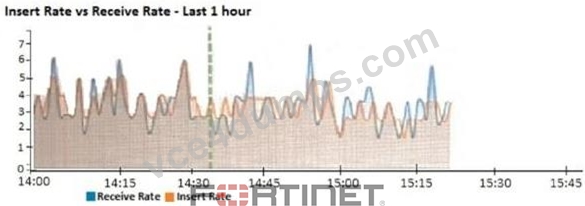
What does the data point at 14:35 tell you?
- A. FortiAnalyzer has temporarily stopped receiving logs so older logs' can be indexed.
- B. The sqlplugind daemon is ahead in indexing by one log.
- C. FortiAnalyzer is indexing logs faster than logs are being received.
- D. FortiAnalyzer is dropping logs.
Answer: C
Explanation:
https://docs.fortinet.com/document/fortianalyzer/6.2.5/administration-guide/47690/insert-rate-vs-receive-rate-widget
NEW QUESTION # 92
A rogue administrator was accessing FortiAnalyzer without permission, and you are tasked to see what activity was performed by that rogue administrator on FortiAnalyzer.
What can you do on FortiAnalyzer to accomplish this?
- A. Click Task Monitor and view the tasks performed by that administrator.
- B. Click Log View and generate a report for that administrator.
- C. View the tasks performed by the rogue administrator in Fabric View.
- D. Click FortiView and generate a report for that administrator.
Answer: A
Explanation:
Reference: https://docs.fortinet.com/document/fortimanager/6.4.1/administration-guide/792943/task-monitor FortiAnalyzer_7.0_Study_Guide-Online.pdf page 54: View the tasks FortiAnalyzer administrators have performed, including progress and status.
NEW QUESTION # 93
What can the CLI command # diagnose test application oftpd 3 help you to determine?
- A. What ADOMs are enabled and configured
- B. What logs, if any, are reaching FortiAnalyzer
- C. What devices are registered and unregistered
- D. What devices and IP addresses are connecting to FortiAnalyzer
Answer: D
Explanation:
https://docs.fortinet.com/document/fortianalyzer/6.2.5/cli-reference/395556/test#test_application
NEW QUESTION # 94
Which two statements are true regarding ADOM modes? (Choose two.)
- A. Normal mode is the default ADOM mode.
- B. You can only change ADOM modes through CLI.
- C. In an advanced mode ADOM. you can assign FortiGate VDOMs from a single FortiGate device to multiple FortiAnalyzer ADOMs.
- D. In normal mode, the disk quota of the ADOM is fixed and cannot be modified, but in advance mode, the disk quota of the ADOM is flexible because new devices are added to the ADOM.
Answer: A,C
Explanation:
Reference: https://help.fortinet.com/fa/faz50hlp/56/5-6-1/FMG-FAZ/0800_ADOMs/0400_ADOM%
20Device%20Modes.htm
NEW QUESTION # 95
Which two statements are true regarding FortiAnalyzer log forwarding? (Choose two.)
- A. Forwarding mode forwards logs in real time only to other FortiAnalyzer devices.
- B. In aggregation mode, you can forward logs to syslog and CEF servers as well.
- C. Aggregation mode stores logs and content files and uploads them to another FortiAnalyzer device at a scheduled time.
- D. Both modes, forwarding and aggregation, support encryption of logs between devices.
Answer: C,D
Explanation:
A) FortiAnalyzer_7.0_Study_Guide-Online.pdf page 148: The log communication between devices can be protected by encryption, with the desired encryption level, using the commands shown on the slide. (You need to interpret this. "Real time" and "aggregation" is about the "moment" when Fortigate sends the logs.
However, no matter the moment, Fortigate will upload logs encrypted or unencrypted based on previous / differente config).
C) FortiAnalyzer_7.0_Study_Guide-Online.pdf page 147: Aggregation: Logs and content files stored and uploaded at scheduled time.
NEW QUESTION # 96
Which three RAID configurations provide fault tolerance on FortiAnalyzer? (Choose three.)
- A. RAID 0+0
- B. RAID 6+0
- C. RAIDO
- D. RAID 5
- E. RAID1
Answer: B,D,E
Explanation:
RAID 1 provides fault tolerance through disk mirroring.
RAID 5 provides fault tolerance by using distributed parity across multiple disks.
RAID 6+0 combines striping with double parity, offering enhanced fault tolerance.
RAID 0 and RAID 0+0 do not provide any fault tolerance, as they focus on performance through data striping but offer no redundancy.
NEW QUESTION # 97
Refer to the exhibit.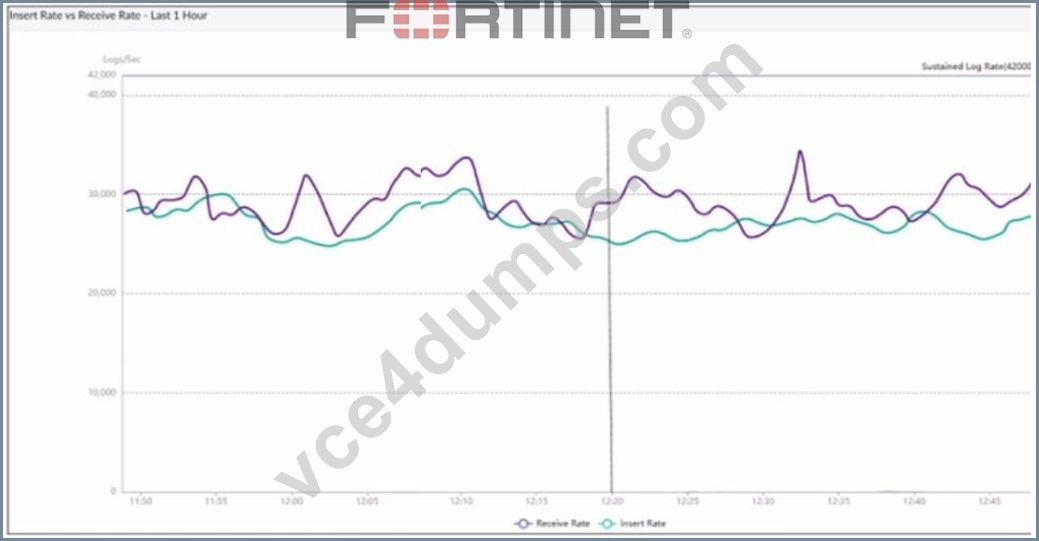
What does the data point at 12:20 indicate?
- A. FortiAnalyzer is using its cache to avoid dropping logs.
- B. The sqlplugind service is caught up with new logs.
- C. The log insert lag time is increasing.
- D. The performance of FortiAnalyzer is below the baseline.
Answer: B
NEW QUESTION # 98
FortiAnalyzer centralizes which functions? (Choose three)
- A. Security log analysis / forensics
- B. Content archiving / data mining
- C. Graphical reporting
- D. Network analysis
- E. Vulnerability assessment
Answer: A,B,C
NEW QUESTION # 99
Which two statement are true regardless initial Logs sync and Log Data Sync for Ha on FortiAnalyzer?
- A. By default, Log Data Sync is disabled on all backup devise.
- B. When Logs Data Sync is turned on, the backup device will reboot and then rebuilt the log database with the synchronized logs.
- C. With initial Logs Sync, when you add a unit to an HA cluster, the primary device synchronizes its logs with the backup device.
- D. Log Data Sync provides real-time log synchronization to all backup devices.
Answer: B,C
NEW QUESTION # 100
Which process is responsible for enforcing the archive file size?
- A. sqlplugind
- B. logfiled
- C. miglogd
- D. oftpd
Answer: D
NEW QUESTION # 101
Which two statements about high availability (HA) on FortiAnalyzer are true? (Choose two.)
- A. FortiAnalyzer HA active-passive mode can function without VRRP.
- B. All devices in a FortiAnalyzer HA cluster must have the same available disk space.
- C. FortiAnalyzer HA supports synchronization of logs as well as some system and configuration settings.
- D. All devices in a FortiAnalyzer HA cluster must run in the same operation mode, either analyzer mode or collector mode.
Answer: C,D
Explanation:
The two correct statements about high availability (HA) on FortiAnalyzer are:
FortiAnalyzer HA supports synchronization of logs as well as some system and configuration settings.
FortiAnalyzer HA synchronizes both logs and certain system configuration settings between the units in the cluster to ensure consistent operation.
All devices in a FortiAnalyzer HA cluster must run in the same operation mode, either analyzer mode or collector mode.
In an HA cluster, all devices must be configured to operat` e in the same mode - either analyzer mode or collector mode-to ensure consistency and proper functionality across the cluster.
The other options, such as VRRP, are not required for HA in FortiAnalyzer, and disk space can vary between nodes but may impact log storage capacity.
NEW QUESTION # 102
Which statement correctly describes RAID 10 (1+0) on FortiAnalyzer?
- A. A configuration with four disks, each with 2 TB of capacity, provides a total space of 4 TB.
- B. 11 combines mirroring striping and distributed parity to provide performance and fault tolerance
- C. It uses striping to provide performance and fault tolerance.
- D. A configuration with four disks, each with 2 TB of capacity, provides a total space of 2 TB.
Answer: A
Explanation:
RAID 10 combines mirroring (RAID 1) and striping (RAID 0). In a RAID 10 setup with four disks, data is mirrored across two pairs of disks, and those pairs are striped for performance. This results in improved performance and fault tolerance, but the total usable storage is 50% of the total raw storage, meaning four 2 TB disks provide 4 TB of usable space.
NEW QUESTION # 103
What does the disk status Degraded mean for RAID management?
- A. The device is writing data to the disk to restore the volume to an optimal state.
- B. One or more drives are missing from the FortiAnalyzer unit.
- C. FortiAnalyzer determined that the parity data in the disk is not valid.
- D. The hard drive is no longer being used by the RAID controller.
Answer: B
Explanation:
When the RAID status is Degraded, it typically indicates that one or more drives in the RAID array have failed or are missing, causing the RAID array to operate with reduced redundancy. In this state, the array is still functioning, but it's at risk because the fault tolerance provided by RAID is compromised.
NEW QUESTION # 104
Which feature can you configure to add redundancy to FortiAnalyzer?
- A. Link aggregation
- B. VLAN interfaces
- C. Primary and secondary DNS
- D. IPv6 administrative access
Answer: A
Explanation:
Link aggregation is a method used to combine multiple network connections in parallel to increase throughput and provide redundancy in case one of the links fail. This feature is used in network appliances, including FortiAnalyzer, to add redundancy to the network connections, ensuring that there is a backup path for traffic if the primary path becomes unavailable.
Reference: The FortiAnalyzer 7.4.1 Administration Guide explains the concept of link aggregation and its relevance to
NEW QUESTION # 105
What FortiGate process caches logs when FortiAnalyzer is not reachable?
- A. sqlplugind
- B. logfiled
- C. miglogd
- D. oftpd
Answer: C
NEW QUESTION # 106
Refer to the exhibit.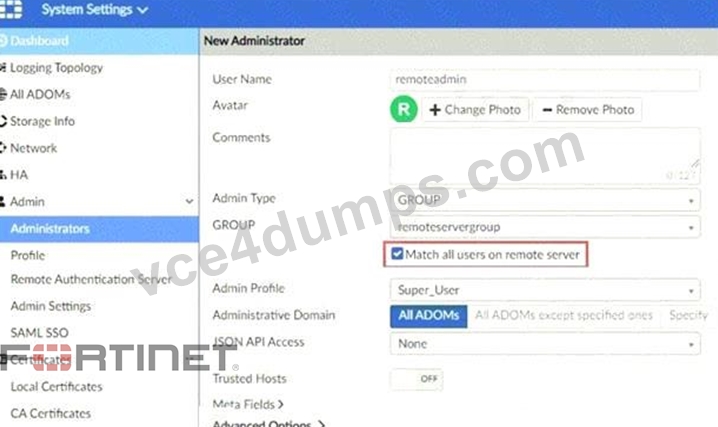
The exhibit shows "remoteservergroup" is an authentication server group with LDAP and RADIUS servers.
Which two statements express the significance of enabling "Match all users on remote server" when configuring a new administrator? (Choose two.)
- A. It creates a wildcard administrator using LDAP and RADIUS servers.
- B. It allows administrators to use two-factor authentication.
- C. Use remoteadmin from LDAP and RADIUS servers will be able to log in to FortiAnalyzer at anytime.
- D. Administrator can log in to FortiAnalyzer using their credentials on remote servers LDAP and RADIUS.
Answer: A,D
Explanation:
Reference: https://docs.fortinet.com/document/fortimanager/7.0.1/administration-guide/858351/creating- administrators
NEW QUESTION # 107
If the primary FortiAnalyzer in an HA cluster fails, how is the new primary elected?
- A. The active port number is checked first.
- B. The configured IP address is checked first.
- C. The configured priority is checked first
- D. The firmware version is checked first.
Answer: C
Explanation:
In the case of a primary device failure, FortiAnalyzer HA uses the following rules to select a new primary:
* All cluster devices are assigned a priority from 80 to 120. The default priority is 100. If the primary device becomes unavailable, the device with the highest priority is selected as the new primary device. For example, a device with a priority of 110 is selected over a device with a priority of 100.
* If multiple devices have the same priority, the device whose primary IP address has the greatest value is selected as the new primary device. For example, 123.45.67.124 is selected over 123.45.67.123.
* If a new device with a higher priority or a greater value IP address joins the cluster, the new device does not replace (or pre-empt) the current primary device automatically.
FortiAnalyzer_7.0_Study_Guide-Online page 62
NEW QUESTION # 108
Which two statements are true regarding FortiAnalyzer log forwarding? (Choose two.)
- A. Forwarding mode forwards logs in real time only to other FortiAnalyzer devices.
- B. In aggregation mode, you can forward logs to syslog and CEF servers as well.
- C. Aggregation mode stores logs and content files and uploads them to another FortiAnalyzer device at a scheduled time.
- D. Both modes, forwarding and aggregation, support encryption of logs between devices.
Answer: C,D
Explanation:
A) FortiAnalyzer_7.0_Study_Guide-Online.pdf page 148: The log communication between devices can be protected by encryption, with the desired encryption level, using the commands shown on the slide. (You need to interpret this. "Real time" and "aggregation" is about the "moment" when Fortigate sends the logs. However, no matter the moment, Fortigate will upload logs encrypted or unencrypted based on previous / differente config).
C) FortiAnalyzer_7.0_Study_Guide-Online.pdf page 147: Aggregation: Logs and content files stored and uploaded at scheduled time.
NEW QUESTION # 109
What is the best approach to handle a hard disk failure on a FortiAnalyzer that supports hardware RAID?
- A. Run execute format disk to format and restart the FortiAnalyzer device.
- B. There is no need to do anything because the disk will self-recover.
- C. Perform a hot swap of the disk.
- D. Shut down FortiAnalyzer and replace the disk.
Answer: C
Explanation:
In a hardware RAID setup, FortiAnalyzer supports hot swapping, which allows you to replace a failed disk without shutting down the device. The RAID controller will automatically rebuild the array using the new disk, minimizing downtime and maintaining data integrity.
NEW QUESTION # 110
What are two benefits of using fabric connectors? (Choose two.)
- A. They allow FortiAnalyzer to send logs in real-time to public cloud accounts.
- B. Fabric connectors allow you to improve redundancy.
- C. You do not need an additional license to send logs to the cloud platform.
- D. Using fabric connectors is more efficient than using third-party polling with API.
Answer: A,B
NEW QUESTION # 111
......
Verified FCP_FAZ_AD-7.4 exam dumps Q&As with Correct 185 Questions and Answers: https://passguide.vce4dumps.com/FCP_FAZ_AD-7.4-latest-dumps.html